
The Prime Minister's Office has clarified that the total sanctioned strength of the PMO has been around 525 in the period 2011-14. As against this, the actual strength of the PMO in the years 2011, 2012 and 2013 was in the range of 407 to 411. The number has now declined to 385.

'It was China's rise that caused the New Cold War in Asia as it prompted the United States to rebalance its forces in Asia to experiment with engagement and containment at the same time,' says T P Sreenivasan.
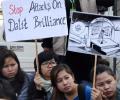
Voicing "dissatisfaction" over remarks by Modi on Friday at a university in Lucknow, the Joint Action Council spearheading the stir asked if the prime minister would now take action against his ministers.

If indeed we want the board to manage the RBI, probably the government should take a close look at the US Federal Reserve system which has a two-part structure - a central authority in Washington, DC, and a decentralised network of 12 Federal Reserve Banks located throughout the country, says Tamal Bandyopadhyay.

'The government is using the Intelligence Bureau to go after NGOs.' 'It is not only the NDA, the UPA also didn't like NGOs.' 'NGOs predominantly work with the poor. So, when you cancel an NGO, the affected are the poor, the Dalits, the tribals, the street children and the marginalised.'
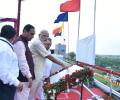
De-scaling of businesses, job losses and subsequent impact on disposable incomes has created negative sentiment among traders, business owners and workers alike, says Abhishek Waghmare.

Following her spat, 'Aunty National' Irani took to Facebook to speak out against her detractors. Here's the Facebook post in response to her critics which Rediff.com represents verbatim:
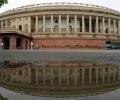
The need for co-ordinated policy between Centre and states was likewise foreseen and assigned.

The change in policy for the three companies, from listing to merger, shows the level of discomfort within the government about their ability to take on the expanded load for insurance coverage with their current financial strength, including the massive premium and claim settlement cover under the proposed universal health coverage plan announced in Budget 2018.

'Deep down, it betrays a transactional view of politics. That, to get, the voter must give,' argues Krishna Prasad.

'We are completely engaged in fighting poverty; alas, our neighbour Pakistan seems only engaged in fighting us.'

India's snooping programme is officially underway and multiple agencies will use internet surveillance system Netra and National Cyber Coordination Centre to keep a tab on suspicious activities on the internet, says Vicky Nanjappa.

'Indira Gandhi and P N Haksar did not want Pakistan to leave as an embittered foe hell-bent on taking revenge for being humiliated so comprehensively.'

the connection between the sunflower mystery and the 'rotatable solar trees' India plans to develop.

Summary of sports events and persons who made news on Monday

Hours after 21 ministers took the oath of office and became a part of Prime Minister Narendra Modi's ministry, speculation began on which minister would be handed which portfolio. However, all speculation ended after the list was announced.

'This health emergency has brought a lot of people together with the common purpose of getting Feluda to play detective as quickly as possible.' 'As a scientist, if we can make a small difference in people's lives, we are happy'

After the United Nations declared June 21 as the International Yoga Day in December last year at India's request, the officers in the Ministry of Ayush began ideating about how to celebrate it in the country.
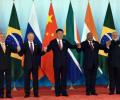
The BRICS also called upon all nations to adopt a comprehensive approach in combating terrorism including countering radicalisation and blocking terror financing sources.

Gleaning lessons from Amit Shah's compendium of Chanakya-isms, the Samajwadi Party is keeping its operations low-key and working on an inclusive strategy.

The voyeurism and poor taste on display in the reportage of the murder case involving Mukerjea's wife reflect the mindset of the society we live in and the media we are exposed to

Unless the judges factor in the ungovernability of technologies and their beneficial owners, present and future Presidents, prime ministers, judges, legislators and officials handling sensitive assignments may become redundant with reference to their age-old roles for securing 'national resources and assets', warns Dr Gopal Krishna.

Can we make high speed 4G Internet available at 10 cents per GB, and make all voice calls free of cost -- that too in a large and diverse country like India? Can we make high-quality but simple breast cancer screening available to every woman, that too at the extremely affordable cost of $1 per scan? Can we make a portable, high-tech ECG machine which can provide reports immediately and that too at the cost of 8 cents a test? Can we make an eye imaging device that is portable, non-invasive and costs 3 times less that conventional devices? Can we make a robust test for mosquito-borne dengue, which can detect the disease on day 1, and that too at the cost of $2 per test? Amazingly, says Dr R A Mashelkar, the eminent scientist, all this has been achieved in India, not only by using technological innovation but also non-technological innovation.

Lt Governor Najeeb Jung, who is now administering Delhi after President's rule was imposed, on Tuesday made it clear that none of the decisions and initiatives taken by the Aam Aadmi Party government will be scrapped, including the 50 per cent subsidy on power tariff.

Claude Arpi, who spent 10 days in the Land of the Dragon, tells us how Bhutan is different from the rest of the world.
Claude Arpi, who spent 10 days in the Land of the Dragon, tells us how Bhutan is different from the rest of the world.

'Communal tension and violent mobs have been part of our country, whichever government is in power. What has happened since the BJP came into power is that individuals or group activities asserting Hindutva have become louder, more aggressive.' 'Now we are finding ourselves in a country where reasoning and thinking have no place, the power lies with the goons.' 'I find any ban, whether on what we write, what we eat, how we dress etc, absolutely abominable. They have no place in a democracy.' Shashi Deshpande on why she joined the writers' protest against the growing intolerance in India.

Just to be clear, "love jihad" -- a concept that claims that Muslim men court Hindu women to convert them to Islam purely to take over India -- doesn't exist, says Mitali Saran
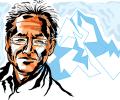
Magsaysay Award winner Sonam Wangchuk speaks to Claude Arpi about his journey, his fights, his hopes and how he became an inspiration for the Bollywood blockbuster.

The Delhi metropolitan area has one of the highest concentrations of population in the world, and suffocating the people of the area on an annual basis should be treated as a crime against humanity, especially when the cause for such suffocation can be controlled, says Arvind Kumar.

'Modi has lost a great opportunity to show himself to be a leader, mentor and path-setter, capable of rising above narrow party interests,', says B S Raghavan, the distringuished civil servant.

This is the joint statement issued by the ministry of external affairs on the visit of US President Barack Obama to India.

Congress president Sonia Gandhi on Saturday held parleys with the chief ministers of Maharashtra and Haryana amidst the possibility of a change of guard in some of the states where it is in power as the party prepares for a massive rejig in the wake of its unprecedented debacle in Lok Sabha polls.

Sectors throw up a wishlist for the Finance Minister.

The MoU was signed by New York Consul Geneal Dnyaneshwar Mulay on behalf of the ICCR and Richard L Edwards, executive vice president for Academic Affairs and interim Chancellor, Rutgers University to initiate this academic partnership.
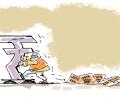
'We have promised to ensure reduced tax rates.'

Empowered in the Modi government, junior ministers have enough on their plate.

AAP candidates from Mumbai, Medha Patkar and Meera Sanyal, are poised to play a crucial and complementary role. While Patkar gives voice to the suffering of people at the grassroots, Sanyal is articulating the key principles that could build a more just and equitable society or economy, says Rajni Bakshi.

'65 per cent were males.' 'Age group of deaths: More were seen from age 51 to 70.' 'Saw some deaths from age 21 to the 40s.' 'About 76 to 77 per cent of patient deaths had some kind of a comorbidity.' 'The main comorbidities were the presence of diabetes, hypertension, some kind of heart diseases.'

The Diaspora is no longer a mere remittance economy. It today claims dual loyalty and demands a say in Indian politics, says sociologist Shiv Visvanathan
